



Where was the
Nuevas Philapinas?
(New Philippines)
caption goes here
[view
larger]
Cover of Thomas Suarez's book
The Manila Galleon brought the first Filipino adventurers to America. Some of these seafarers who jumped ship and settled in the coastal town of Mexico. The early exploration of the southwestern United States were done by several Spanish missions from Mexico creating Pueblos in the Indian (Native American) territory.

“The absence of any evidence of Philippine mapmaking, nor even
any clear mention of them by early visitors, is a great enigma.”
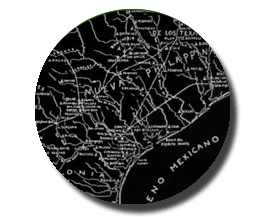
California, New Mexico, and the New Philippines (now called Texas) were part of the Mexican extended territory. The Filipino community in Mexico was mobilized to help populate the region as the Spanish met hostility from the Native American and the claim became complacent during the 18th century. It ended when the French Explorers appeared from the Missisippi River. Most of the old Spanish town's names remained today, as Texas became the only nation that became a state in 1835. The name- NuevasPhilapinas as noted in the above map that could be found in the book of Heusinger, Edward W. Early Explorations and Mission Establishments in Texas.?
The return voyages of the Manila Galleon followed
the cyclone weather system of the upper Pacific Ocean almost parallel
to the Equator. The Marianas and Caroline Islands were administered by
the Spanish Authority from Manila.
The first European to visit the island group was Spaniard, Diego de Rocha,
in 1526. The islands were originally called the New Philippines until
1696 when they were renamed the Caroline Islands. Occupied by Spain, Germany,
Japan and the USA, Pohnpei experienced 100 years of foreign rule because
it proved to be an ideal supply stop for the Pacific expeditions.
The absence of any evidence of Philippine mapmaking,
nor even any clear mention of them by early visitors, is a great enigma.
There is no record that maps played any role in the bustling intercourse
that had developed in the many islands of the Philippines, even though
entrepreneurs from Luzon were adventurous enough to have established a
trading colony in Malaya before the Portuguese burst on the scene at the
turn of the sixteenth century. When Thomas Cavendish returned to England
in 1588 he brought a map he acquired in the Philippines, but it was of
Chinese, not Southeast Asian, origin. In the mid-eighteenth century Alexander
Dalrymple, the first head of the British Hydrographic Office, reported
that a servant from Luzon had given him a map whose bearings generally
agreed with Dalrymple's own, but we do not know whether that 'indigenous'
map was ultimately based on Filipino or Spanish information.
The information about Alexander Dalrymble is from Early Mapping of Southeast
Asia, a major new work by ABAA member Thomas Suarez, published by Periplus
Edition (H.K.), 1999, and distributed in the US by Charles E. Tuttle Co.
